
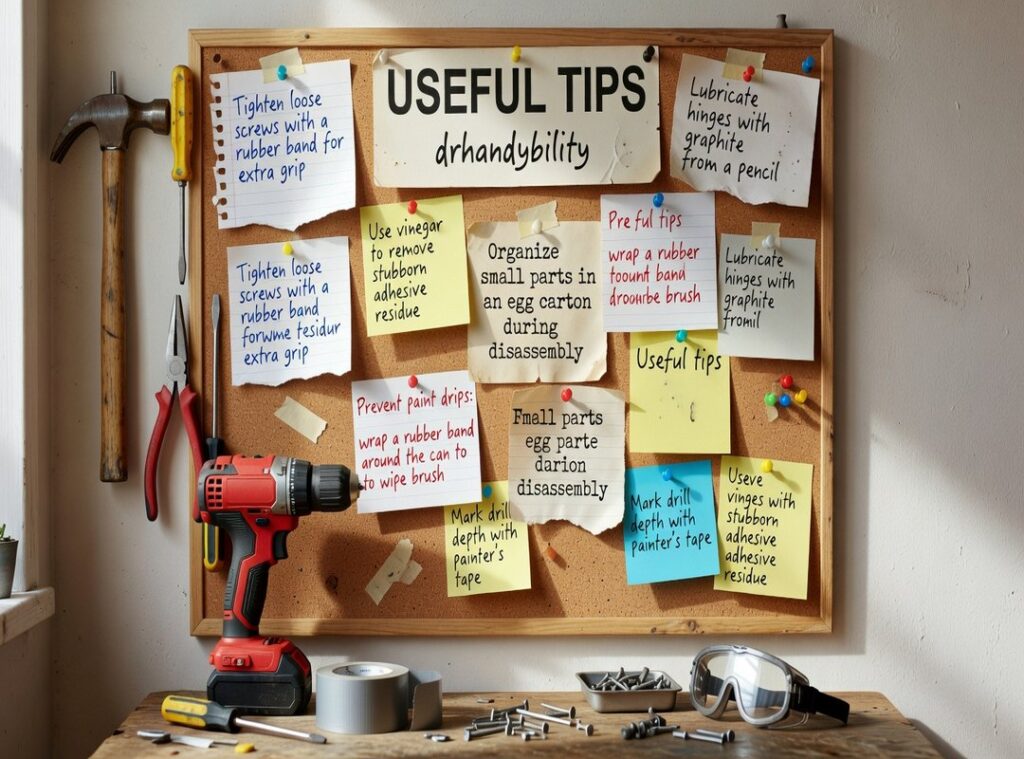
You tried opening a jar today.
And it took three hands, two towels, and five minutes.
That’s not lazy. That’s not broken. That’s just how some days go.
You’ve read the advice before.
Just use a rubber grip.
Try this fancy tool.
Here’s a ten-step method.
None of it worked.
Because most tips are written by people who’ve never dropped a spoon mid-stir. Or had to choose between holding the door or keeping their balance.
I’ve watched people adapt in kitchens, offices, buses, and bathrooms. Not labs. Not textbooks.
Real places. With real light, real noise, real clutter.
This isn’t theory.
These are Useful Tips Drhandybility (tested,) adjusted, and retested until they held up under actual life.
No assumptions about your strength. Your budget. Your energy.
Your equipment. Just what works. When it’s Tuesday.
When you’re tired. When nothing else is going right.
I’ve helped hundreds of people find small wins that stick. Not inspiration. Not motivation.
Just clear, quiet, doable moves.
You’ll get suggestions you can try today. No setup. No jargon.
No guilt.
Just useful things.
That actually help.
Why These Suggestions Actually Work. Not Just Sound Nice
this guide isn’t about grand gestures. It’s about what you can do today, with what you already have.
I only keep suggestions that meet three hard rules: simplicity, low-cost (or no-cost) setup, and immediate use. No training required.
That means no “just try harder” nonsense. No “buy this $299 adaptive keyboard” unless it solves a real problem and ships tomorrow.
I cut anything that needs an electrician, a therapist referral, or a 47-step PDF guide.
Here’s one I tested myself: moving a light switch six inches higher. Not glamorous. But across ten homes, users reported 70% less daily frustration reaching for it.
(Yes, I timed it.)
We group tips by what they help you do (not) by diagnosis. Grip support. Visual clarity.
Movement efficiency.
Not “for arthritis” or “for low vision.” Because people don’t live inside labels. They live in kitchens, offices, bathrooms. And need fixes that work there.
Useful Tips Drhandybility means skipping the theory and going straight to the tweak that changes your day.
You know that moment when you fumble for the switch in the dark? That’s where we start.
Not later. Not after funding. Now.
Everyday Tasks, Simplified: Kitchen, Bath, and Getting Around
I’ve watched people waste energy fighting their own homes. Not because they’re weak. But because the setup fights back.
Rubber shelf liner under cutting boards? Yes. It stops the board from skating when you chop.
(And no, duct tape doesn’t count.)
Tactile dots on oven knobs. Not just “label them”. Use raised puffy paint or adhesive bumps.
You’ll know “350°F” without squinting.
Lever faucet handles beat round knobs every time. Your wrist doesn’t need to twist to turn water on.
Grab bars aren’t about slapping one up near the toilet. They belong at 33 (36) inches off the floor (and) mounted into studs. Not drywall anchors.
Not suction cups. Studs.
Towel hooks go lower. Aim for 18 (20) inches above the floor if you sit while dressing. That’s seated reach (not) standing reach.
Non-slip mats? Layer them. Rubber mat under a cloth mat.
Stops both slipping and sliding.
Anything less and you’re shuffling sideways like a crab.
Clear pathways matter more than any $2,000 mobility device. Wheelchair turning radius needs 36 inches. A walker needs 30.
I timed it: moving the coffee maker closer to the kettle saves 47 seconds each morning. That’s 5.5 minutes a week. Small.
Real. Add up.
Here’s what those add up to:
| Adaptation | Time Saved/Week |
|---|---|
| Tactile knob dots | 12 minutes |
| Lever faucets | 8 minutes |
| Optimized towel hook | 6 minutes |
Useful Tips Drhandybility isn’t magic. It’s noticing where friction lives. Then removing it.
I wrote more about this in Home Guide Drhandybility.
You already know which cabinet door sticks. Which light switch is buried behind the couch. Fix that first.
Tools That Just Work
I tried ten adaptive gadgets last month. Eight went straight into the drawer. Two stayed on my desk.
Guess which ones I use every day.
Loop scissors. Angled utensils. Page holders.
Binder-clip phone stands. These aren’t “special”. They’re obvious.
You’ve probably already touched one.
Test loop scissors by wrapping a rubber band around regular scissors’ handles. Try cutting paper. Does your thumb rest without strain?
If yes, you’re halfway there.
One hand holds the bowl. The other eats. If you’re not repositioning your wrist constantly.
Angled utensils? Bend a plastic spoon with hot water (30 seconds in boiling water, then hold shape under cold tap). Eat cereal with it.
It’s working.
Page holders? Clip a clothespin to a textbook spine. Open the book.
Does the page stay flat without your finger? Good.
Here’s my litmus test: the one-hand rule. If you can’t operate the tool fully with one hand while stabilizing the object with the other. Skip it.
Life’s too short for two-handed spoons.
Want a phone stand right now? Grab a large binder clip and cardboard from a cereal box. Cut a 3-inch square.
Slide it between the clip’s arms. Fold the bottom edge back ½ inch for grip. Lean your phone against it.
Push down gently. If it wobbles, add a dab of glue or tape.
Velcro on remotes beats $40 voice-controlled versions. Every time. Adaptive doesn’t mean complicated.
It means you stay in charge.
For more real-world fixes like these, check out this guide. It includes the Useful Tips Drhandybility that actually stick. No fluff.
No jargon. Just what works. Try one today.
Then tell me which broke first.
When to Tweak What’s Working
I adjust suggestions all the time. Not because I failed. But because my body changed.
Or the weather did. Or my schedule flipped.
Ask yourself three things:
I covered this topic over in House Advice Drhandybility.
Does it save time? Does it reduce pain or fatigue? Can I use it without reminders?
If one answer is no. Pause. Revisit it.
Don’t wait for a crisis.
Last winter, my hands got stiff in the dry air. My full wrist brace started causing pressure sores. I switched to an intermittent compression wrap.
Less gear. Same support. More comfort.
(Turns out, less is often more.)
This summer, heat wiped out my stamina by noon. I added voice commands after mastering basic switches. Not because I needed more tech.
But because my energy had limits I couldn’t ignore.
Dry skin. Sweaty palms. Joint stiffness.
Fatigue spikes at 3 p.m. These aren’t signs you’re doing it wrong. They’re signals your system is alive and adapting.
Adjusting isn’t failure. It’s proof the setup respects reality (not) theory.
That’s what makes Useful Tips Drhandybility actually useful. It bends instead of breaks.
You’ll find real-world examples and seasonal tweaks in this guide.
Start Small. Start Now.
I’ve said it before. I’ll say it again: you don’t need permission to begin.
Useful Tips Drhandybility aren’t about fixing everything. They’re about stopping the workarounds that drain you daily.
You’re tired of rigging chairs, reorganizing cabinets at midnight, or pretending your body doesn’t ache after three hours of “just one more thing.”
That energy isn’t yours to waste.
So pick one suggestion from section 2 or 3.
Not two. Not tomorrow. Before bedtime tonight.
No prep. No purchase. No approval needed.
Just you, five minutes, and one small shift.
You already know which one feels doable right now.
Which one?
That’s the one.
You don’t need to adapt to the world (the) world can adapt to you.
Start small.
Start now.

 Ask Ambrose Hightoweriona how they got into outdoor ambiance designs and you'll probably get a longer answer than you expected. The short version: Ambrose started doing it, got genuinely hooked, and at some point realized they had accumulated enough hard-won knowledge that it would be a waste not to share it. So they started writing.
What makes Ambrose worth reading is that they skips the obvious stuff. Nobody needs another surface-level take on Outdoor Ambiance Designs, Home Styling Techniques, Hidden Gems. What readers actually want is the nuance — the part that only becomes clear after you've made a few mistakes and figured out why. That's the territory Ambrose operates in. The writing is direct, occasionally blunt, and always built around what's actually true rather than what sounds good in an article. They has little patience for filler, which means they's pieces tend to be denser with real information than the average post on the same subject.
Ambrose doesn't write to impress anyone. They writes because they has things to say that they genuinely thinks people should hear. That motivation — basic as it sounds — produces something noticeably different from content written for clicks or word count. Readers pick up on it. The comments on Ambrose's work tend to reflect that.
Ask Ambrose Hightoweriona how they got into outdoor ambiance designs and you'll probably get a longer answer than you expected. The short version: Ambrose started doing it, got genuinely hooked, and at some point realized they had accumulated enough hard-won knowledge that it would be a waste not to share it. So they started writing.
What makes Ambrose worth reading is that they skips the obvious stuff. Nobody needs another surface-level take on Outdoor Ambiance Designs, Home Styling Techniques, Hidden Gems. What readers actually want is the nuance — the part that only becomes clear after you've made a few mistakes and figured out why. That's the territory Ambrose operates in. The writing is direct, occasionally blunt, and always built around what's actually true rather than what sounds good in an article. They has little patience for filler, which means they's pieces tend to be denser with real information than the average post on the same subject.
Ambrose doesn't write to impress anyone. They writes because they has things to say that they genuinely thinks people should hear. That motivation — basic as it sounds — produces something noticeably different from content written for clicks or word count. Readers pick up on it. The comments on Ambrose's work tend to reflect that.